
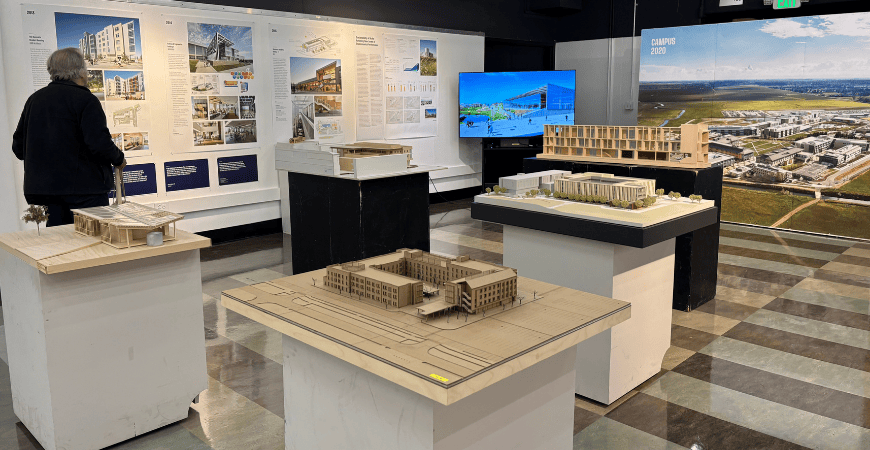
From open farmland in California’s Central Valley to a global model for sustainable design, UC Merced’s architectural story is currently on view as part of a special exhibit at UC Berkeley’s Bauer Wurster Hall.
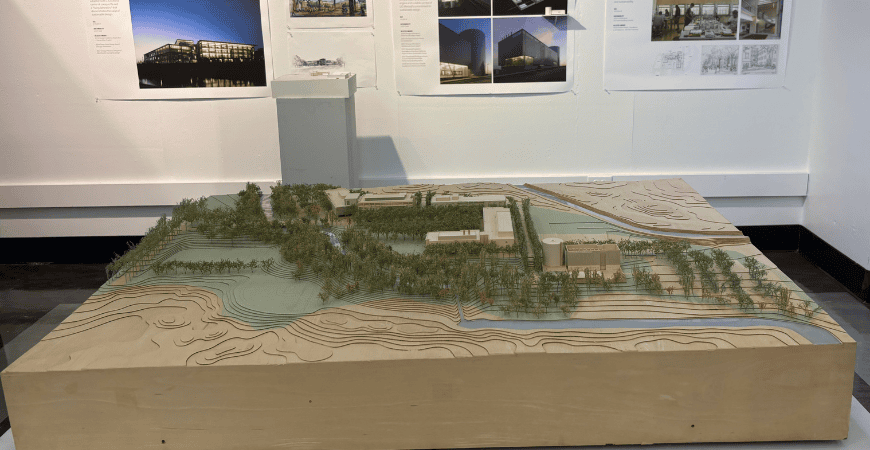
Located in one of Berkeley’s most iconic Brutalist buildings and the home of the College of Environmental Design, “From the Ground Up: Building UC Merced” features oversized photographs, architectural models and sketches that trace Merced’s ambitious growth while creating a visual and conceptual bridge between the University of California’s first and newest campuses.
The exhibition coincides with UC Merced’s 20th anniversary and launched with an opening-night symposium on Jan. 29. Moderated by Brian Harrington, director of physical and environmental planning at the UC Office of the President, the event brought together several of the campus’s original architects and planners alongside academic leaders. The conversation explored UC Merced’s rapid evolution over the past two decades, examining how the ideals that shaped the university’s earliest days continue to influence its trajectory.
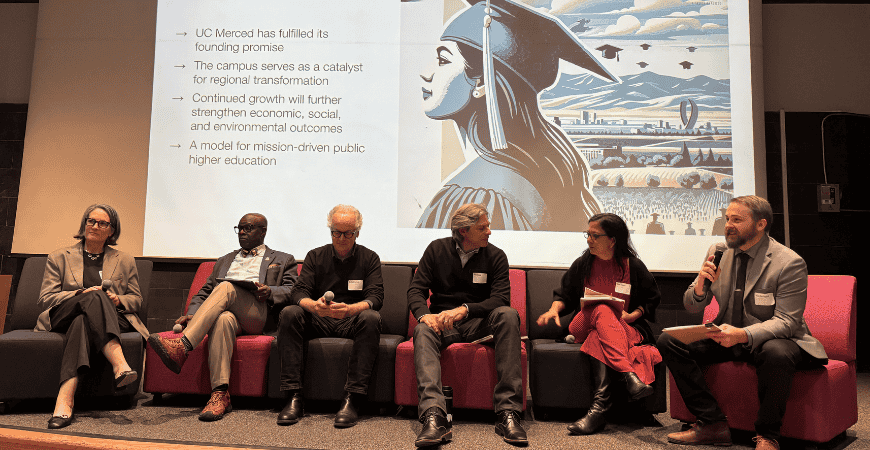
UC Berkeley Assistant Vice Chancellor and Campus Architect Wendy Hillis placed UC Merced within the broader history of UC campus design, emphasizing how architecture reflects shifting ideas about place, identity and purpose.
“The original campus architect was Frenchman Emile Bernard,” Hillis said, recalling early debates surrounding UC Berkeley’s master plan. “There was a lot of angst around the fact that it was a Frenchman who won. There were concerns about what it meant to build this great university using a model that wasn’t American.”
Hillis contrasted Berkeley’s vision with other UC campuses that followed their own architectural philosophies.
“For as much as UC Berkeley is about monumentality, about this white city on a hill imposing order on the landscape, you see Santa Cruz embracing landscape,” she said. “That contrast raises a really interesting question: What is the University of California, and what imagery do we use to represent it?”
UC Merced, Hillis said, reflects a later shift toward architecture rooted in place and vernacular. The challenge ahead lies in balancing growth with stewardship, she said.
“Looking at the axes and open spaces, our challenge now is about the amount of land we have and how we continue to grow students and faculty,” Hillis said. “What are the special places and landscapes that need to be saved, and where can we take increased density?”
Michael Duncan, a design partner at Skidmore, Owings & Merrill, described UC Merced’s character as the product of an iterative process.
“We’re here to give our impressions of the campus. We all worked there before, and we all had a hand in these things,” Duncan said.
“This idea of evolution is really important,” he added. “Master plans can start one way and evolve over time. Buildings define a campus incrementally, and ideas or ideals set 25 years ago can still shape the campus today.”
Duncan pointed to the campus library, today known as the Leo and Dottie Kolligian Library, as a formative project in establishing UC Merced’s architectural identity.
“The library was one of the critical first buildings,” he said. “It was also student services, administration and many of the initial classrooms. The architectural guidelines for the campus were developed at the same time as these buildings.”
Rather than prescribing rigid rules, Duncan explained, architects established shared principles as construction progressed. This approach allowed sustainability concepts to become embedded in the campus’s culture from the start.
“There’s another really powerful story here about the creation of one of the most sustainable universities in the country,” he said.
Tim Stevens, a principal at SCB Architects and a member of the firm’s campus environments leadership team, said UC Merced’s design was guided by a search for authenticity.
“One of the most compelling questions in designing a new UC campus from scratch is: What is the character of the place?” Stevens said. “For UC Merced, that meant rooting the campus in the Central Valley’s agricultural landscape.
“Most UC campuses were once fairly barren and remote pieces of land,” he added. “The initial buildings at Merced used honest material expression and a shared architectural vocabulary. They gave the university an immediate sense of stability and permanence.”
Those early choices, Stevens said, shaped later phases of development, including the Merced 2020 expansion, which emphasized a mixed-use campus model.
“The library wasn’t just a library,” he said. “It was the student center and the campus store. That mixing of uses became inspirational for future buildings.”
Lilian Asperin, a partner at WRNS Studio, described the years between 2015 and 2020 as a pivotal moment for the campus.
“The public-private partnership, or P3, pulled together broad expertise with deep financial backgrounds and allowed the campus to move at speed,” Asperin said. “It was an incredible solution to the challenge of first funding.”
“What often gets lost is how much courage it took to make it real,” she added. “It was teamwork in the truest sense: public and private partners aligning around a shared mission.”
Asperin emphasized the importance of that mission, which was doubling the size of the campus to serve a region and student population with significant unmet need.
“There was a shared understanding that we were serving first-generation students,” she said. “That sense of purpose was powerful.”
UC Merced Vice Chancellor and Chief Operating Officer Daniel Okoli concluded the symposium by noting that the campus’s physical form cannot be separated from its founding mission.
“The founding vision talked about expanding access to the University of California in the Central Valley and advancing social and economic mobility,” Okoli said. “It also talked about sustainability. That set the tone.”
For Okoli, the campus’s most lasting impact is cultural. He pointed to how students responded during campus protests in 2024.
“Our students behaved differently,” he said. “They took care of the campus. When the encampment ended, they cleaned the grounds and left it better than they found it.”
“That says something about the kind of students who come from this place,” Okoli added. “They go into the world and begin to change it.”
